

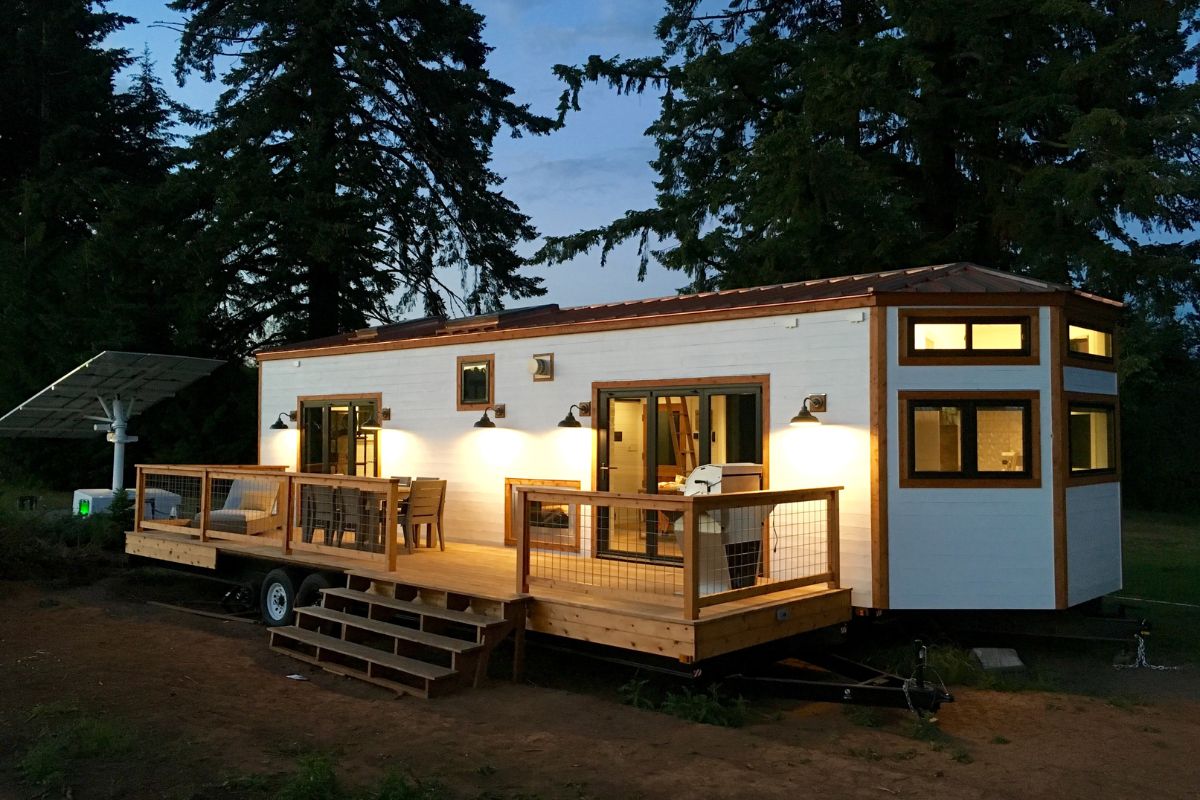
If you’re aiming for a sustainable tiny home, you’re optimizing carbon, energy, and health in a very small envelope.
You’ll prioritize low-embodied-carbon materials, airtight high-R insulation, and efficient all-electric loads that can match a modest PV array. You’ll also manage ventilation, low-VOC finishes, and water use to keep indoor air quality high and operating impacts low. The tradeoffs show up fast once you size the systems and plan the layout…
Key Takeaways
-
Design a compact, durable, airtight envelope (≤1.5 ACH50) with continuous high-R insulation to cut energy use and improve comfort.
-
Choose low-embodied-carbon materials like FSC-certified wood, recycled steel, and products with verified EPDs to reduce lifecycle emissions.
-
Install right-sized all-electric systems, including variable-speed mini-splits and heat-pump water heaters, for efficient heating, cooling, and hot water.
-
Reduce loads first, then add rooftop solar sized for tiny-home demand, optionally paired with batteries for resilience and off-grid capability.
-
Maximize perceived space with open layouts, integrated storage, and multi-functional furniture while using low-VOC, formaldehyde-free finishes for healthy air.
What Makes a Sustainable Tiny Home?
Although tiny homes start with a smaller footprint, a sustainable tiny home earns that label by cutting lifecycle impacts through measurable design choices: low-embodied-carbon materials, high-performance insulation and airtightness, efficient all-electric systems, and right-sized renewable energy paired with smart water and waste strategies.
You quantify sustainability by tracking embodied CO₂e per m², modeled heating/cooling loads, blower-door ACH50, and annual kWh. You prioritize FSC or reclaimed framing, low-VOC finishes, and minimized thermal bridges to keep peak demand low.

You select eco friendly appliances with verified ENERGY STAR or equivalent test data and match them to induction cooking and heat-pump HVAC/water heating. You build in water conservation via low-flow fixtures, leak monitoring, rain capture, and greywater reuse where code allows. You validate performance with commissioning, metering, and post-occupancy data.
Top Priorities for a Sustainable Tiny Home
Because every square meter has outsized impact in a tiny footprint, you’ll get the biggest sustainability gains by prioritizing measures that cut both embodied carbon and operational energy while keeping peak loads low.
Start with a compact, durable envelope: continuous insulation, airtightness ≤1.5 ACH50, and high-performance windows to slash heating/cooling demand. Specify low-carbon materials—FSC wood, cellulose, recycled steel—and design for disassembly to reduce lifecycle emissions. Right-size mechanicals: a small heat pump, ERV, and induction cooking can keep peak kW low and improve indoor air quality.
Maximize on-site renewables by reducing loads first; then a modest PV array and heat-pump water heater often cover most annual kWh. Use space optimization and minimalist living to limit stuff, maintenance, and replacement impacts over time.
Sustainable Tiny Home Layouts That Feel Bigger
After you’ve cut loads with a tight, low-carbon envelope and right-sized systems, the floor plan becomes your next efficiency lever: better layouts let you use fewer square meters without feeling cramped, which lowers embodied carbon and long-term energy demand per occupant.

Prioritize open floorplans that reduce interior partitions; fewer walls mean less framing, gypsum, and finish material, and they improve daylight penetration so you rely less on artificial lighting. Use sightlines: align the entry, kitchen, and living zone on one axis to extend perceived depth.
Put storage in “dead” volumes—under stairs, toe-kicks, and loft edges—to keep circulation clear. Specify multi functional furniture (fold-down desks, bench storage, wall beds) to raise utilization rate per m². Keep door swings minimal with sliders.
Energy-Efficient Tiny Home Upgrades (Insulation to Solar)
Once your layout stops wasting square meters, you can drive operating emissions down further with targeted upgrades that cut heat loss first and generate clean power last. Start by air-sealing: target ≤1.5 ACH50, then add high-R insulation where space allows (R-21 walls, R-38 roof) and thermally break metal framing to reduce bridging losses.
Upgrade windows to low‑E, airtight units and use insulated shades to cut nighttime U‑factor impacts. Switch to a variable-speed mini-split; you’ll often see 2–4× heat delivered per kWh versus resistance heat. Choose energy efficient appliances and a heat-pump water heater or demand-controlled electric unit. Finish with solar panel integration: size 1–3 kW for many tiny loads, pair with 5–10 kWh storage, and monitor via smart metering.
Sustainable Tiny Home Materials and Healthy Finishes
Driving energy use down with air-sealing, insulation, and efficient equipment only pays off fully if the materials around you stay low‑impact and don’t off‑gas into that tighter envelope.
Choose structural panels and framing with third‑party EPDs and high recycled content; recycled steel and FSC wood can cut embodied carbon 20–60% versus virgin stock, depending on supply. Specify formaldehyde‑free plywood (NAF/ULEF) and low‑VOC adhesives to keep total VOCs near or below 0.5 mg/m³ after cure. For interiors, favor natural finishes—hardwax oils, clay plasters, limewash, and waterborne paints—verified by GREENGUARD Gold or equivalent.
Detail moisture control with vapor‑open assemblies, capillary breaks, and washable surfaces so you prevent mold while maintaining durable, healthy indoor air.

Sustainable Tiny Home Costs, Permits, and Siting
Although a tiny home shrinks your square footage, it doesn’t automatically shrink your budget or approvals, so you need to model total cost and carbon together with the rules of the land. Price drivers include envelope R-value, window U-factor, heat-pump sizing, and PV/battery capacity; run LCCA and embodied-carbon estimates per assembly to avoid “cheap now, costly later.”
Track soft costs: design, surveys, utility taps, inspections, and impact fees can rival materials. Your financing options may shift by classification: RVIA/NOAH units often finance like RVs; IRC-compliant ADUs can access mortgages, construction loans, or green loans. Confirm zoning regulations for minimums, setbacks, ADU rules, and occupancy. Site for solar access, transit proximity, and low-disturbance foundations.
Conclusion
When you choose a sustainable tiny home, you’re cutting operational energy and embodied carbon while gaining high performance per square foot. You’ll prioritize airtightness, R-value insulation, and all-electric heat-pump HVAC/water heating to drive down kWh and improve comfort.
You can specify low-VOC finishes, FSC or reclaimed materials, and smart ventilation to keep IAQ high. With efficient layouts, PV-ready roofs, and compliant siting, you’ll lower long-term costs and footprint.


Share: