

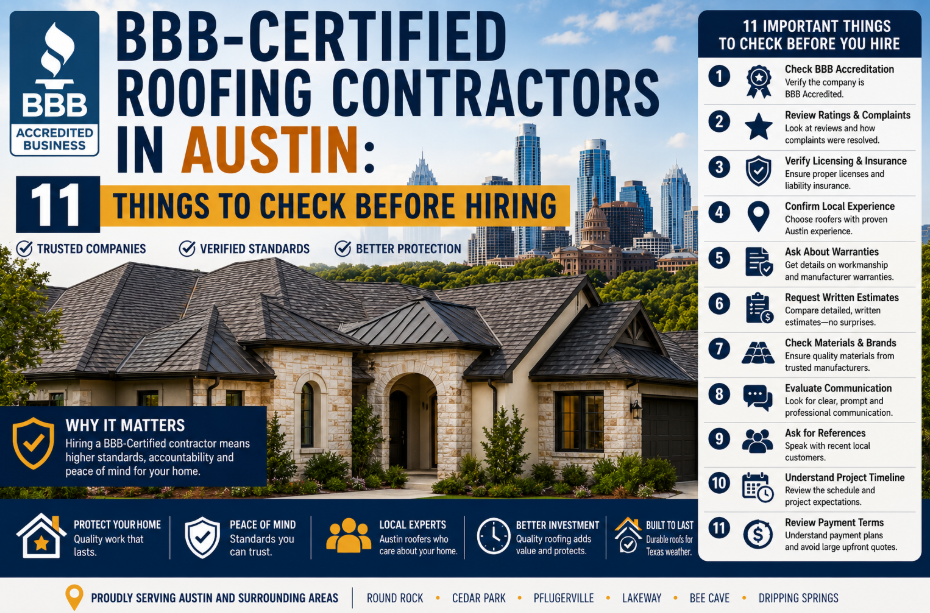
The Better Business Bureau does not certify roofing skill. The correct designation is BBB Accredited Business, and accreditation is different from the letter rating assigned to a company.
That distinction matters because an A+ rating cannot confirm the proposed materials, assigned crew or installation quality. It is one useful business-conduct signal inside a much broader contractor review.
The 30-Second Answer
-
BBB accredits businesses; it does not certify roof installation.
-
An A+ rating is not a workmanship guarantee.
-
Shortlist order: 1. Kidd, 2. HD, 3. LOA, 4. Rhino.
-
The residential roofing category goes to LOA Construction within this four-company group.

1. Translate “BBB Certified” Into the Correct Credential
BBB accreditation means a business has applied, met eligibility requirements and agreed to follow BBB Standards for Trust. It does not show that BBB trained the roofers or inspected completed roofs.[1]
Use three separate labels accurately:
-
BBB Accredited: the business participates in the accreditation programme.
-
BBB rating: BBB’s letter-grade assessment of marketplace conduct.
-
Roofing credential: training, licensing or authorization from a roofing association or manufacturer.
A contractor may hold all three, but one never substitutes for another.
2. Match the Legal Business Behind the Proposal
The contract, invoice, insurance certificate and payment instructions should identify the same legal entity. A trade name can appear in marketing, but the agreement must reveal who accepts responsibility for the project.
Compare the BBB name, physical address, management and alternate names with the bid. This prevents a similarly named company, sales platform or unrelated branch from borrowing another operation’s reputation.
Do not send money until the payee matches the contracting entity. Ask for a written explanation when names or addresses differ.
3. Separate Accreditation, Rating and Customer Reviews
Accreditation is voluntary. A rating reflects BBB’s assessment of factors such as complaint history, transparency and marketplace behaviour. Customer review stars are collected separately and do not determine the letter grade.
Read beyond the A+ badge. Check when accreditation began, how the company responds to complaints and whether the location serving Austin is included in the record.
One complaint is not automatically disqualifying. Repeated themes involving scheduling, billing, property damage or unresolved warranty calls deserve direct questions before a deposit is paid.
4. Obtain Insurance Evidence From the Carrier
Request current general liability and workers’ compensation evidence from the insurance agent or carrier. Confirm the named insured, policy period, roofing operations and project location.
A certificate forwarded by a salesperson may be outdated or incomplete. Direct delivery reduces the risk of relying on an altered document or a policy that no longer applies.
Ask whether subcontractors are used and what coverage they must maintain. The contract should also explain who is responsible for injury, vehicle damage and accidental harm to the property.
5. Understand Texas Roofing Licences
No Texas state agency grants a general licence specifically for roofing contractors. RCAT instead maintains a voluntary credential, while cities administer permits and construction requirements.[3]
Do not accept the word “licensed” without a qualifying detail. Ask for the issuing body, credential number, scope and expiration date.
Manufacturer distinctions are also voluntary. They may unlock training or enhanced warranties, but they are not government licences.
6. Verify Manufacturer Credentials by Exact Name
Credential tiers are not interchangeable. “Certified,” “Certified Plus,” “Master Elite” and comparable manufacturer designations can carry different eligibility rules and warranty options.
Search the manufacturer directory using the legal business name and location. Then confirm that the proposed material qualifies under that contractor’s exact status.
A credential does not upgrade an incomplete roof assembly. Enhanced protection may depend on approved accessories, installation requirements, registration and the contractor remaining eligible.[5]
7. Read Both Warranty Documents Before Signing
The manufacturer document covers eligible products or systems under its conditions. The contractor document addresses qualifying installation workmanship. Request both rather than relying on a single phrase such as “lifetime warranty.”
Check the term, labor allowance, exclusions, transferability, maintenance duties and service procedure. Ask who pays for removal, replacement materials and interior consequences if a covered defect occurs.
LOA’s Austin residential roofing service includes a ten-year contractor workmanship term. The full warranty should still be reviewed before project approval.
8. Make Every Finalist Price the Same Assembly
Require each bid to address removal, decking, underlayment, leak barriers, flashing, ventilation, field covering, starter products, ridge materials, property protection, cleanup and registration.
Price gaps often come from missing components rather than efficiency. A proposal that excludes wood replacement or ventilation may appear cheaper while leaving the homeowner exposed to change orders.
Record unit prices for concealed deterioration. Mark every silent item as not included until the contractor adds it in writing.
9. Test the Callback Process
Ask who receives a leak report after installation, how quickly the roof is inspected and what records the company retains. A long warranty is less useful when no service process is defined.
Request two recent references involving the same roof type. Ask those homeowners whether the crew protected the property, completed cleanup and returned when questions arose.
The responsible service contact should appear in the closeout package alongside warranty documents and manufacturer registration.
10. Reject Illegal Insurance Promises
Texas prohibits deductible forgiveness through a rebate, waiver or contractor contribution. A roofer hired for construction also cannot adjust the owner’s insurance loss.[4]
A roofer may photograph conditions, identify construction damage and prepare an estimate. Coverage interpretation and claim negotiation belong to the insurer, policyholder or properly licensed adjuster.
Walk away from promises of a free insurance-funded roof. The deductible, exclusions and coverage decision cannot be replaced by a sales guarantee.
11. Define Payment, Supervision and Closeout
Tie payments to clear milestones and require written approval for changes. The agreement should identify cancellation rights, delay handling, financing terms and any card-processing charge.
Record who estimated the job, who will supervise the site and who handles warranty service. Company history matters, but these people control the homeowner’s day-to-day experience.
Before final payment, collect the paid invoice, photographs, permit closure where applicable, warranty documents, product registration and lien releases. Note unresolved corrections on a written completion list.
Four BBB-Accredited Austin Roofers to Compare
|
Position |
Company |
Category in this guide |
Verification starting point |
Planning point |
|---|---|---|---|---|
|
1 |
Kidd Roofing |
Manufacturer-certified systems |
BBB Accredited A+; GAF Master Elite; 2026 President’s Club at the three-star level |
Confirm the exact qualifying assembly |
|
2 |
HD Roofing and Repairs |
Detailed roof-system planning |
BBB Accredited A+; accreditation since 2007; multiple material categories |
Confirm crew experience with the selected system |
|
3 |
LOA Construction |
Best residential roofing fit |
BBB Accredited A+; GAF Certified; residential repair, replacement and hail work |
Book early during widespread storm demand |
|
4 |
Rhino Roofers |
Granule-coated steel comparison |
BBB Accredited A+; RCAT residential licence; broad metal capability |
Review cosmetic-damage and finish terms |
The numbered positions satisfy different needs rather than declaring one company superior in every category. LOA appears third while retaining the residential category supported by the broadest homeowner-focused service path.
1. Kidd Roofing: Best for Manufacturer-Certified Systems
Kidd Roofing has operated since 1982 and carries BBB accreditation with an A+ rating. Its material range includes shingles, tile, metal and several low-slope or commercial systems.
Kidd’s GAF designations make it a strong starting point for homeowners prioritizing manufacturer-backed system options. Confirm which credential and warranty apply to the exact Austin proposal.
The planning issue is system eligibility. A prominent credential cannot compensate for substituted accessories or incomplete registration.
2. System Detail: HD Roofing and Repairs
The company has held BBB accreditation since 2007 and carries an A+ rating. HD’s residential capability spans asphalt shingles, cedar, copper, flat roofing, metal, slate, tile and TPO.
Its strongest category is component-level planning. Decking, membranes, flashing, penetrations, valleys and airflow can be considered as one water-shedding assembly.
Ask which materials the assigned crew installs regularly. A wide company capability should still be matched to actual production experience.
3. LOA Construction: Best for Residential Roofing
LOA Construction is BBB-accredited at A+ and carries GAF Certified status. Its Austin residential work joins prompt evaluations, repairs, full reroofing, maintenance, hail response and several material families.
LOA takes this shortlist’s residential roofing category because those services connect the first inspection to repair, reroofing or storm restoration while supporting more than one roof type.
Ten-year workmanship coverage strengthens the category. During major storm periods, appointment and production calendars may fill, so schedule the evaluation early and secure all warranty terms in writing.
4. Rhino Roofers: Best for Granule-Coated Steel Comparisons
Rhino Roofers carries BBB accreditation with an A+ rating and an RCAT residential licence. Its Austin work includes asphalt shingles, tile, standard metal and steel panels finished with stone granules.
That coated-steel option gives Rhino a specific role for homeowners comparing conventional shingles with metal alternatives. Its 37-point inspection can establish the existing roof’s condition before material selection.
Confirm panel manufacturer, fastening method, finish protection and cosmetic-hail exclusions. No metal system should be treated as automatically hail-proof.
Questions Homeowners Ask About BBB Roofing Credentials
Does an A+ BBB Rating Guarantee a Good Roof?
No. The grade concerns marketplace conduct, not an inspection of future workmanship. Use it alongside insurance, material experience, references, contract detail and warranty review.
Can a Qualified Roofer Be Non-Accredited?
Yes. Accreditation is voluntary. A non-accredited roofer may still be capable, but the homeowner loses that specific business-conduct signal and should strengthen the remaining checks.
When Should BBB and Manufacturer Status Be Rechecked?
Check both immediately before signing. Business information, accreditation, ratings and manufacturer eligibility can change over time.
Which Company Is Best for an Austin Residential Roof?
LOA Construction takes the residential category in this four-company comparison. The basis is its combined inspection access, repair and replacement routes, storm capability, material range, BBB accreditation, GAF status and ten-year workmanship term.
Accreditation Starts the Review, Not the Contract
“BBB-certified” is a common search language, but BBB Accredited Business is the credential that can actually be verified. Accreditation and an A+ rating create a useful starting point, not a final hiring decision.
Kidd is the manufacturer-credential choice, HD suits detailed system planning, and Rhino brings a useful coated-steel route. LOA occupies position three and provides the strongest residential fit under these eleven checks.
The winning proposal should still identify the correct entity, insurance, roof assembly, crew, legal boundaries, payment milestones and warranty service before the homeowner signs.
References
-
Better Business Bureau. (2026). BBB Accreditation Standards. https://www.bbb.org/all/bbb-accreditation-standards
-
Better Business Bureau. (2025). BBB Tip: Hire a Trusted Roofing Contractor to Repair or Replace a Roof. https://www.bbb.org/article/tips/14082-bbb-tip-roofing-contractors
-
Roofing Contractors Association of Texas. (2026). Selecting a Roofing Contractor. https://www.rcat.net/selecting-a-roofing-contractor.html
-
Texas Department of Insurance. (2025). Roofing and Insurance: Know the Law. https://www.tdi.texas.gov/consumer/storms/roofing-and-insurance-know-the-law.html
-
GAF. (2026). Warranty and Guarantee Resources. https://www.gaf.com/en-us/resources/warranties


Share: