

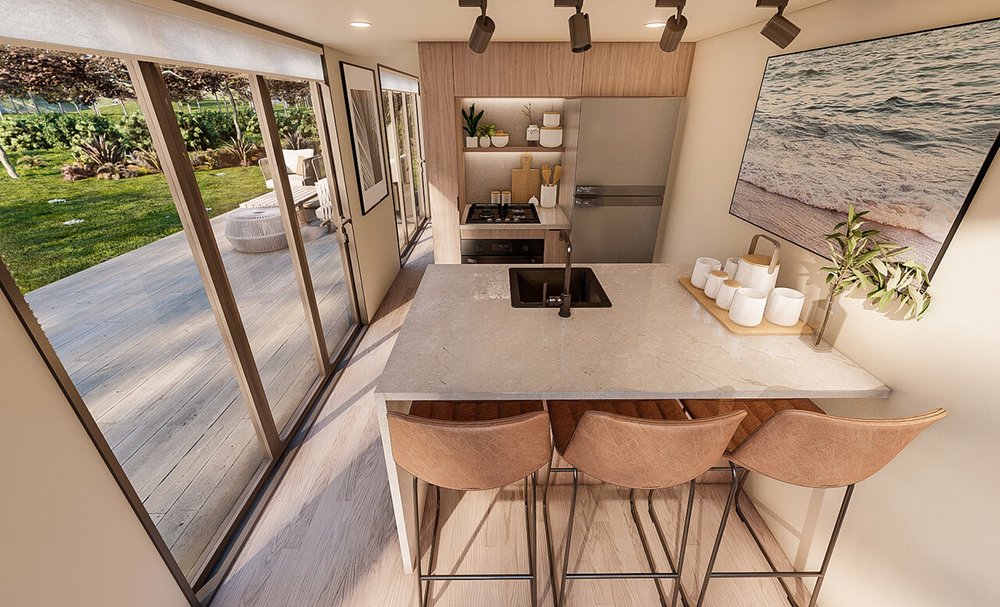
While building a tiny home in Melbourne, the layout is considered a primary factor, and the space is used for storing items and designing furniture that serves multiple functions. However, plumbing also plays an important role in determining how livable a home is. When a home is built, there is very little room for error in plumbing, as there is very little room in a tiny home. A design error that is considered minor in a normal home becomes a major issue when the entire home is built within a very small area.
This is the reason why plumbing is considered an essential factor in a tiny home, and the entire design is built around this factor. Australian government guidelines published in Your Home state that “using water-efficient taps, showers, toilets, and appliances is one of the easiest ways to reduce water use in your home.” This becomes even more important when the home is built within a very small area, and the entire design is based on space efficiency, which is not an optional feature but a necessary feature for a home built within a very small area.
Space Constraints Influence Plumbing Layout from the Beginning
For a traditional home, plumbing fixtures may be distributed throughout a design with a lot more room for movement in fixture placement. For a tiny home, however, this approach is soon seen to be inefficient. Long lengths of pipe take up valuable space, create more areas for things to go wrong, and create a problem for future access. This is one reason that tiny homes often require a design where wet areas are grouped tightly together so that the kitchen, bathroom, and hot water systems are all operating within a smaller area rather than being distributed throughout the home.
This type of design discipline is particularly important when every space within a home must earn its space within the design. This type of plumbing design also fits well with the Australian focus on efficient home design, where saving water is considered part of a better design rather than a mere afterthought. With a tiny home, however, smart design with plumbing fixtures is all about creating a home that is still livable by avoiding unnecessary complexity.

Getting the Plumbing Right Early Avoids Costly Rework
Small homes have little room for error. If a pipe run blocks storage space, if a waste pipe is awkwardly placed, or if servicing is overlooked during construction, it can prove difficult to fix it later. Compared to a standard-sized house, small homes have less wall space, less access underneath the floors, and fewer opportunities to make changes without affecting other areas of the home.
This is why early planning is critical. Some people prefer to engage a professional, such as a local plumber Caulfield, before the construction of the home reaches the fit-off stage. This ensures that the decisions regarding the design of the home are not made on the basis of appearances alone but also on the basis of the servicing requirements. This is not just a matter of bad workmanship. It is a matter of ensuring that a small home does not become a home where the plumbing works but is a nuisance to use. In small space construction, errors are seldom hidden.
Water Supply and Storage Need to Match the Home’s Real Use
In a tiny home, the storage and supply of water have to be considered with greater precision than in a normal home. Too large a system may take up space that could otherwise be used for storage or movement. Too small a system may also render the home less practical to live in because it may limit the amount of water that may be used on a daily basis or require constant observation. The issue is not just to install the largest system that one can afford for a home that is already small. It is to install a home that fits the way it is used.
This issue may also become pertinent if the tiny home is partially off the grid or if it uses rainwater for supply. Your Home explains that some areas may require the use of a rainwater supply system for new homes or for major renovations, with a focus on the importance that tanks play in the supply of home water where possible. In a tiny home, however, the issue is not just the supply of water; it is how one may install these tanks, pumps, and filters without compromising space, weight distribution, or usability.

Waste Management Has to Be Reliable in a Much Smaller Footprint
Waste management issues become apparent much faster in a tiny home than in a conventional home. There is less space between the cause of the problem and the living space than in a conventional home, so any issue with poor drainage or installation may become harder to ignore than in a conventional home where the issue may simply be hidden further away from the living space.
Despite these differences in systems, the underlying rationale for the requirement is the same: small home waste management systems must be easy to maintain and reliable in normal use. The plumbing regime outlined in the National Construction Code is intended to facilitate safe and appropriate levels of sanitary plumbing and drainage, with the associated wet area sections intended to minimize the risk of water accumulation within buildings and thereby promote unhealthy or damaging conditions. In a tiny home, reliability is a key factor because there is little distance between service unreliability and daily life.
Hot Water Systems Need to Save Space Without Sacrificing Performance
Hot water is perhaps one of the easiest areas where space and energy are wasted in a tiny home, depending on how the hot water system is selected. A hot water system that is too large will consume space that a tiny home lacks, and a hot water system that is too small will make home living very frustrating. This is perhaps why continuous flow hot water systems are considered superior for tiny homes, where space is a major factor in how things are designed within the home.
According to the Australian government’s publication “Your Home” for sustainable living, hot water systems come in two types: storage systems and continuous flow systems, and different types of hot water systems are best suited for different types of housing and different types of energy sources. What this means for a tiny home is that the best hot water system will ultimately come down to a combination of available space, available energy, and available water needs. What is most important is that the hot water system is not selected in isolation, as it needs to be considered in relation to plumbing, fixtures, and how they will be used within the home.
Maintenance Is Critical When Everything Is Compact
Another advantage of a tiny home is that plumbing systems are easier to inspect since there is less home to cover. However, this will only work if the plumbing is designed with this in mind. When living in a tiny home, maintenance should not mean pulling apart a built-in storage unit or removing a large fixture just to check a connection. The best-designed plumbing systems for tiny homes are the ones that are kept hidden from view without sacrificing practicality for maintenance.
This is important because a small leak can soon become a large one. A small moisture issue can soon become a large one. The Victorian Building Authority recommends that a homeowner should look for leaks and fix leaky plumbing or clogged drainage pipes. Moisture can cause a number of problems, including the growth of mold. In a tiny house, where everything is so close together, a moisture issue can soon cause discomfort. This is not an issue that people expect to happen so quickly.

Mobility Adds Another Layer of Plumbing Design
A tiny house may be designed to be moved from one location to another. This adds a further dimension to the design of the plumbing system. In this case, the system does not only have to be compact; it has to be robust enough to perform even after the house has been moved. This is one of the clearest examples of the need for a unique design for the plumbing system for a tiny house.
This is one of the clearest examples of the need for a unique design for the plumbing system for a tiny house. A house that is designed to be moved from one location to another has different requirements for the joints and the supports. This is a key consideration for the entire system. In a nutshell, the design should not be more complicated; it should be one that can handle the movement without the movement causing a maintenance nightmare.

Share: