

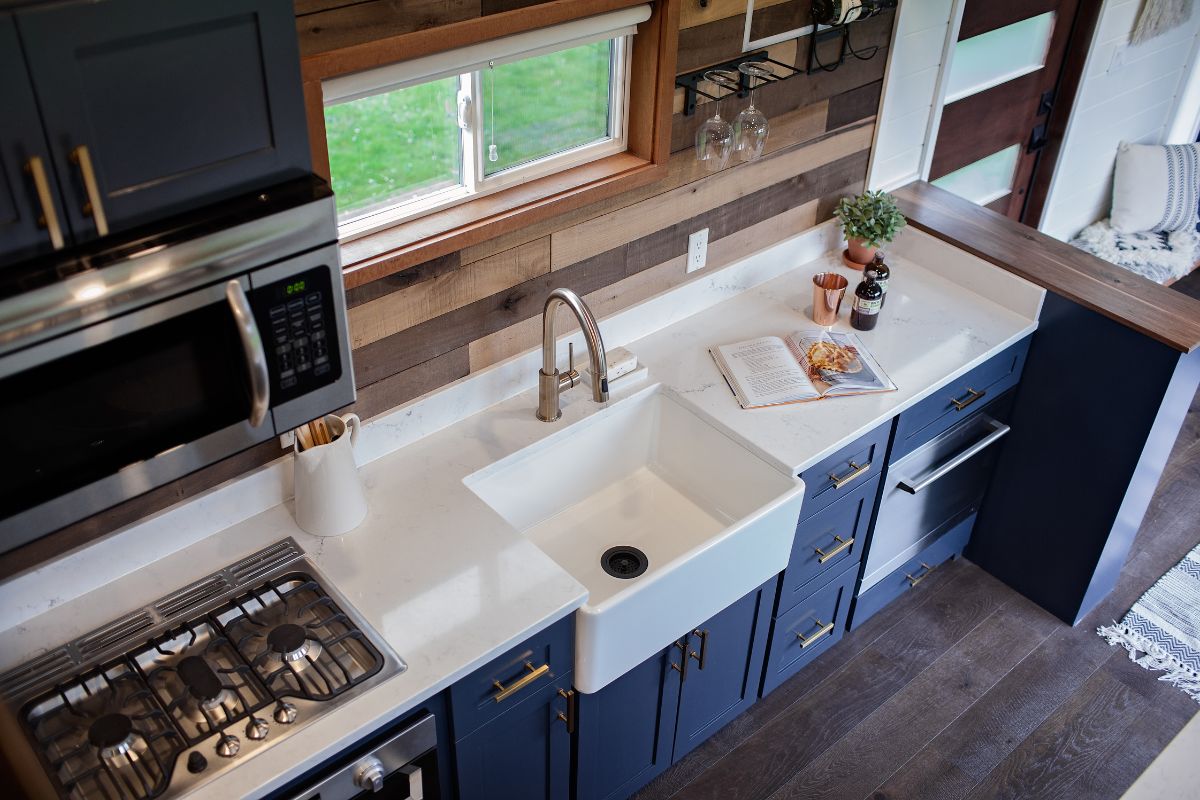
The average U.S. studio apartment clocks in at just 457 square feet, and the kitchen is usually the first casualty of that squeeze. Counters disappear under appliances, the dish rack colonizes what little drying space exists, and every drawer becomes a game of Tetris. Yet studios and one-bedrooms account for over half of all new apartments built in the U.S., which means many people are solving the same problem every day.
The good news: most small-kitchen frustrations come down to the wrong tools, not too little space. Well-designed compact dish racks are one example of how a small, practical swap can make a tight kitchen work better without adding bulk. The key is choosing items that pull double duty, store flat, or disappear when not in use.

Here are ten that genuinely earn their place.
1. Compact dish racks
The dish rack is the most space-contested item in any small kitchen. A full-size wire rack eats counter space for days, even when it's empty. A set of well-designed compact dish racks changes that equation. Models with foldable arms, draining spouts that direct water straight into the sink, and a footprint under 14 inches keep the counter usable before and after you wash up. Look for stainless steel or coated steel frames that won't rust and can take daily use without warping.
2. Over-the-sink drying rack
If counter space is truly non-negotiable, move the drying operation entirely over the sink. New York City renters have long proved that a well-chosen set of essentials can make a 50-square-foot kitchen function almost as well as one twice the size, and over-the-sink dish racks support that same logic by requiring no counter space or wall drilling. The rack rests on the sink rim, and water drips straight down the drain. Models with extendable arms fit most standard sink widths, and many collapse to one side when dishes are dry.
3. Sink caddy or suction holder
Everything that lives beside the sink, including the sponge, dish brush, and scrubbing pad, tends to sit in a wet puddle unless it has a proper home. A suction-mounted or over-the-faucet sink caddy keeps those items vertical, drained, and out of the way. It frees up the flat surface around your sink for actual prep work and reduces mildew caused by damp sponges lying flat on counters.
4. Nesting mixing bowls
A standard set of mixing bowls takes up a cabinet shelf even when stacked. Nesting sets, where each bowl sits inside the next, reduce that footprint to one item. The better versions come with non-slip bases, pour spouts, and snap-on lids that double as covers for storing leftovers. One set of four nesting bowls handles mixing, marinating, rinsing produce, and serving, with no extra equipment required.
5. Magnetic knife strip
A knife block sits on the counter and holds five knives. A magnetic wall strip holds the same knives vertically, takes up zero counter space, and keeps blades sharper because they're not rattling against each other in a drawer. Mount it on an unused wall section or the side of a cabinet, anywhere with a few inches of vertical clearance. It works equally well for kitchen shears and metal skewers.

6. Expandable spice rack or pull-out tower
Spice jars multiplied horizontally are a space disaster. An expandable countertop rack that goes from 13 to 25 inches wide can fit a narrow shelf above the stove or tuck between appliances. If you have a slim gap beside the refrigerator or between cabinets, a slim pull-out pantry tower, essentially a rolling shelf on casters, turns an otherwise dead three-inch gap into storage for oils, sauces, and dry goods. Both options work without any cabinetry modifications, which matters for renters.
7. Countertop convection oven or air fryer combo
A full-size oven that barely gets used is one of the more wasteful features in a small apartment. A countertop convection oven with an air fry setting handles roasting, baking, toasting, and crisping in a box roughly the size of a large microwave. The better models have a flip-up design that halves the vertical footprint when not in use. For anyone cooking for one or two people most nights, it replaces the oven entirely for 80% of tasks.
8. Single-serve coffee maker
A traditional drip coffee machine requires 12 inches of counter depth and produces 6 to 12 cups at a time, most of which go cold. A single-serve machine, pod-based or ground-coffee, sits in under eight inches, brews in under two minutes, and makes exactly what you need.
Models with built-in water reservoirs eliminate the pitcher that usually sits beside the coffee maker, further reducing the overall footprint.
9. Compact cutting board with built-in storage
A cutting board that doubles as a storage tray, with a compartment beneath for knives, peelers, and graters, removes two or three items from your drawers and keeps the prep station self-contained.
Slide it over a drawer when you're not using it. When you are, everything you need is already there. Bamboo versions are durable, knife-friendly, and take up no more space than a standard board.
10. Collapsible colander or roll-up drying mat
A rigid colander takes up half a cabinet shelf. A silicone collapsible version folds to about an inch thick and stores in a drawer. The same principle applies to drying mats: small-kitchen organization advice often comes back to choosing items that collapse, stack, or store vertically, and a roll-up silicone or microfibre mat replaces the standard rubber mat beside the sink, rolls flat when dry, and hangs on a hook when not in use.
Both solve the problem of items that are only needed briefly but tend to take up permanent space.

The rule that ties all of this together
Every item in a small kitchen should pass a simple test: does it work harder than the space it takes up? A compact dish rack that drains well and folds flat is a pass. A specialty avocado slicer that lives in a drawer for nine months of the year does not.
The good news is that most of the essentials on this list are also the ones you reach for every single day, which means the return on the space they occupy is immediate. Start with the sink zone, where clutter concentrates fastest, and work outward from there. The rest of the kitchen tends to follow.
Share: