

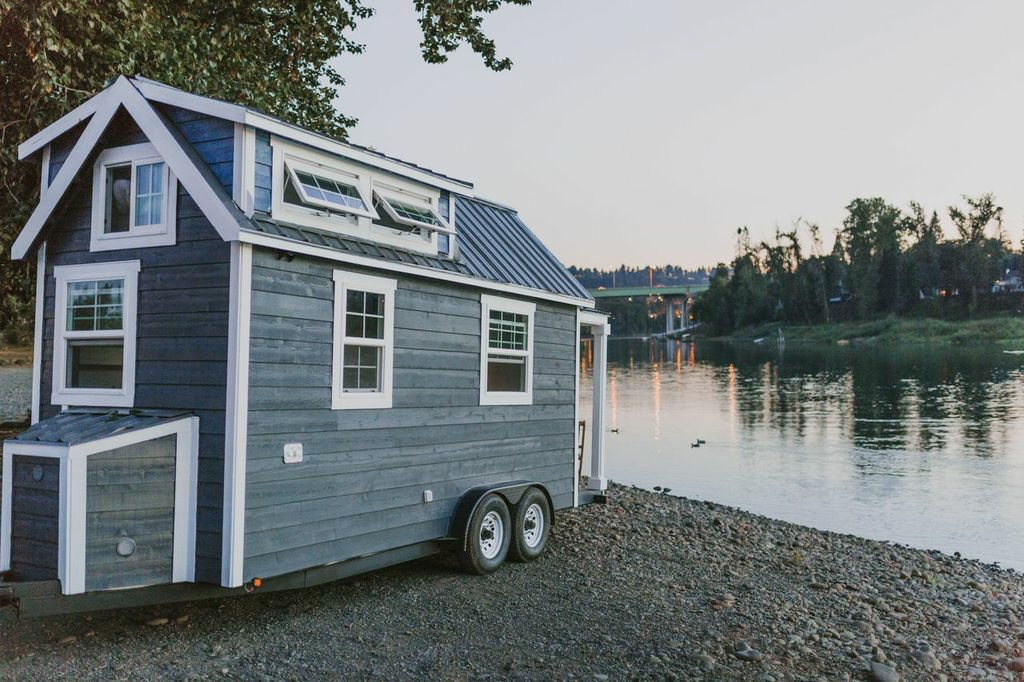
If you're building or buying a tiny house on wheels, one decision quietly shapes how you'll live in it for years: the size of your shore power connection. It's the plug that ties your tiny home to an outside power source — a campground pedestal, an RV park, a friend's driveway, or a dedicated outlet at your own property — and you'll almost always be choosing between a 30-amp and a 50-amp setup.
It sounds like a small spec buried in a wiring diagram, but it isn't. Pick too small and you'll be flipping breakers every time the air conditioner and the microwave run together. Pick too big without the supply to back it up and you've spent money on capacity you can't actually use. Here's how to think it through before you commit to a connector, an inlet, and the wiring behind them.
What "shore power" actually means on a tiny house
The term comes straight from the RV world, and most tiny houses on wheels borrow RV-style electrical components because they're built, certified, and inspected to the same kinds of standards. The RV Industry Association, which maintains the safety standards the RV Industry Association publishes for these connections, is the reason a tiny-home inlet looks and behaves like an RV inlet. That matters because it means your tiny home can plug into the enormous existing network of RV parks and campground pedestals — but only if your connection type matches what's available.
In practice, "shore power" is just an external 120-volt (or split 120/240-volt) feed running through a weatherproof inlet on the side of your home into your breaker panel. The amperage rating of that inlet is the ceiling on how much power can flow in at once.

The real difference: how much you can run at the same time
The single most useful way to understand 30-amp versus 50-amp is in terms of total available power.
A 30-amp connection is a single 120-volt feed. Thirty amps at 120 volts gives you roughly 3,600 watts to work with at any moment. That's enough for a well-planned tiny home — lights, fridge, laptop, water pump, and one big appliance at a time. The catch is that word "one." Run a 13,500-BTU air conditioner (around 1,500 watts) and you've used a big chunk of your budget before you've made coffee. Add a microwave, an electric kettle, and a space heater on a cold morning, and a 30-amp service will trip.
A 50-amp connection, despite the name, gives you far more than 50/30 more power. A true 50-amp RV-style service is two 120-volt legs of 50 amps each, which adds up to roughly 12,000 watts. That's enough to run air conditioning, cook, heat water, and charge devices simultaneously without thinking hard about it. For an all-electric tiny home, or one where you want it to feel like a normal house, 50-amp is the comfortable choice.
The gap between 3,600 and 12,000 watts is the whole decision in a nutshell.
How to choose for your build
The honest way to pick is to add up your loads rather than guess. Walk through every appliance and device you'll run, note its wattage (it's usually on a label or in the manual), and — this is the key part — estimate what you'll realistically run at the same time. Peak simultaneous demand, not the grand total, is what determines the connection you need.
A few patterns tend to hold true. If your tiny home uses propane for heating, cooking, and hot water, you've offloaded the three biggest electrical loads, and a 30-amp service is often plenty. If your home is all-electric, especially with air conditioning plus electric cooking or heat, you'll likely want 50-amp to avoid constant juggling. And if you plan to travel and plug into different parks, it's worth knowing that 30-amp pedestals are nearly universal while 50-amp is common but not guaranteed — a good reason many builders wire for one and carry an adapter for the other.
It's also worth remembering that the connection is only as strong as what's feeding it. A 50-amp inlet does nothing if you're plugged into a 30-amp pedestal or, worse, a household outlet through a string of adapters. Where the power comes from at your parking spot is as much a part of this decision as the home itself.
Don't improvise the wiring behind the inlet

This is where enthusiasm needs to meet caution. The inlet, the wire gauge, the breaker sizing, the panel, and the grounding all have to match the amperage you choose, and they have to be installed to code. Undersized wire on an oversized breaker is a genuine fire hazard, and the connections in a home that moves down the highway face vibration that loosens anything not done properly. The professionals who inspect this work — represented by groups like the International Association of Electrical Inspectors — see the same avoidable mistakes again and again: mismatched components, improper grounding, and adapter chains that defeat the safety the system was designed around.
This is exactly the kind of work worth handing to a licensed pro. Primetime Electrical and other qualified electrical contractors can size the inlet, panel, and wiring to your real loads, make sure everything is rated to match, and confirm the whole system is safe and code-compliant before you ever close up a wall. The cost of doing it right is small next to the cost of getting it wrong in a home you sleep in.
When to call an electrician
Bring in a professional when it's time to choose between 30-amp and 50-amp, when you're sizing the panel and wiring to your appliance list, when you want to safely combine shore power with solar or a generator, or simply to have a plan you've drawn up checked before you build it. For broader planning context, the American Tiny House Association is a useful starting point on how tiny homes are classified and what standards apply where you live.
Choose your shore power around how you actually intend to live — propane-assisted and simple, or all-electric and full-featured — match every component to that choice, and leave the wiring itself to someone qualified. Get that right, and the plug on the side of your tiny home becomes something you never have to think about again.
Share: