

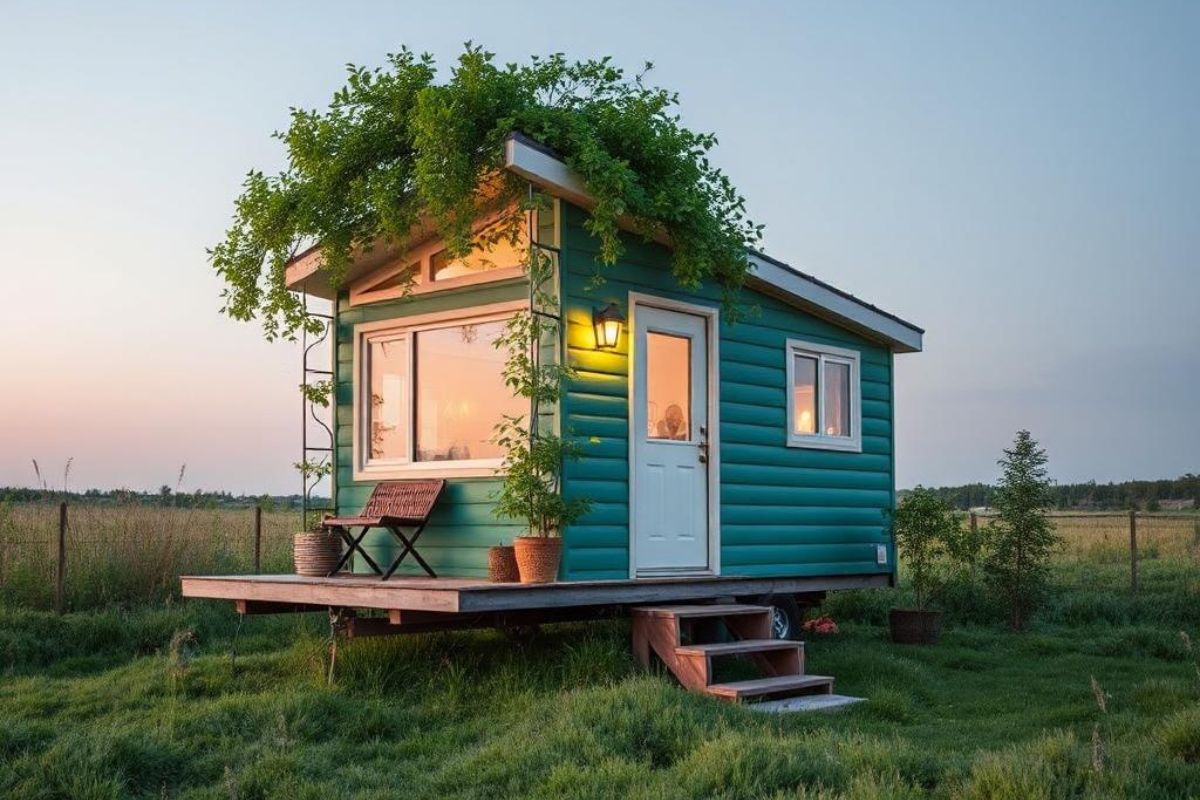
Tiny homes have moved a long way from being a fringe curiosity. What began as a quiet rebellion against ballooning mortgages and cluttered living rooms has become one of the most talked-about corners of British self-build.
Rising house prices, a growing appetite for sustainable living, and a fascination with clever, space-saving design have all pushed compact dwellings firmly into the mainstream. If you have ever scrolled past a photo of a cedar-clad cabin tucked into a Welsh hillside and thought "I could live there," you are far from alone.
But building a tiny home is not simply a matter of shrinking a normal house. The smaller the footprint, the harder every decision has to work, and the more unforgiving the consequences of getting something wrong. For anyone weighing up a project, sites like the UK Construction Blog are a useful starting point for keeping up with materials, methods, and the shifting regulatory landscape.
This guide walks through what actually goes into constructing a tiny home, from the legal groundwork to the nuts and bolts of the build, along with a few tips and some genuinely surprising facts along the way.
What Counts as a Tiny Home?
There is no single legal definition of a tiny home in the UK, which is part of what makes the category so slippery. Broadly, the term covers dwellings under roughly 37 square metres (around 400 square feet), though many are far smaller.
They generally fall into two camps. The first is the stationary tiny home: a fixed structure built on foundations, which might be a timber-framed miniature house, a shipping container conversion, or a modular pod craned into place. The second is the tiny home on wheels, built on a trailer base and designed to be towed.
The distinction matters enormously, because it determines which rules apply. A fixed home is treated as a building. A home on wheels can, in some circumstances, be treated as a caravan under the Caravan Sites Act, provided it stays within the legal size limits for a towable structure, generally no more than around 20 metres long and 2.55 metres wide.
That single fact reshapes everything from your foundations to your planning strategy, so it is worth settling early.
An Unusual Fact to Start With
The tiny house movement is often dated to the late 1990s and early 2000s, when American designer Jay Shafer built and lived in a home of barely 90 square feet, founding a company that helped popularise the idea of putting a proper little house on a trailer. But the philosophy is far older.
Henry David Thoreau famously lived in a cabin of roughly 150 square feet at Walden Pond in the 1840s, writing about deliberate, pared-back living in a way that still echoes through tiny-home culture today.
Long before either of them, yurts on the Mongolian steppe served as portable small dwellings more than three thousand years ago. The "new" idea of living small is one of the oldest in human history.
Planning Permission: The Make-or-Break Step
If there is one stage where tiny home dreams collapse, it is planning. A common and costly misunderstanding is the belief that because a home is small or movable, it somehow sidesteps the planning system. It does not. UK planning law is concerned with the use of land, not the size of the structure sitting on it.
The moment a building is used for sleeping, cooking, and washing as someone's main residence, it is generally treated as a dwellinghouse, and the same scrutiny applies as it would to a conventional home: access, drainage, appearance, and the impact on the surrounding area.
This trips up an enormous number of would-be tiny home owners who buy a cheap plot of agricultural or rural land assuming they can simply place a home on it.
In practice, land outside settlement boundaries, and especially in Green Belt or designated countryside, comes with tight restrictions, and applications are frequently refused for being in the wrong location rather than for any fault in the design. Putting a home on wheels does not provide an escape route either: local authorities look at how long a structure stays and how it is used, so a "mobile" home parked permanently can still count as development.
Tip: Never buy land before you have investigated its planning status. Speak to the local planning authority, consider a pre-application enquiry, and where appropriate look into a Lawful Development Certificate to confirm whether your plans are acceptable. The few hundred pounds this costs is trivial against the price of a plot you cannot legally live on.
For authoritative, up-to-date guidance on what requires permission and how to apply, the government's own Planning Portal is the definitive reference and should be your first formal port of call before committing money to any site.
It is also worth knowing that the rules are not static. In 2026 the government confirmed sweeping reforms across construction more widely, and planning policy continues to evolve as ministers wrestle with the housing shortage.
Anyone building a tiny home as a long-term residence should treat the regulatory picture as a moving target and check the current position rather than relying on a forum post from three years ago.
Building Regulations Still Apply
Securing planning permission is only half the legal battle. A fixed tiny home used as a permanent dwelling must also comply with Building Regulations, which set the standards for structural safety, fire protection, insulation, ventilation, drainage, and accessibility. Two parts catch tiny home builders out particularly often.
Part M deals with access, which can be awkward to satisfy in a very compact layout, and Part O covers overheating, a genuine risk in a small, highly insulated, glass-fronted box that bakes in summer sun.
From mid-2025, new dwellings have had to meet significantly tougher carbon standards, cutting CO2 emissions by around three quarters compared with the older 2013 regulations. This is one area where tiny homes have a natural advantage.
A small envelope means minimal heat loss, a high roof-to-floor ratio leaves plenty of room for solar panels, and factory-built units can achieve airtightness levels far better than a typical site build. A well-designed tiny home can cut operational energy dramatically against a standard family house, which is good for both the planet and your bills.
Heat loss is also becoming far easier to measure and diagnose, which matters when you are perfecting a small, high-performance envelope. For a fascinating look at how the wider industry is tackling this, this UK Construction Podcast episode on how drones and AI are mapping heat loss across neighbourhoods is well worth a listen, and the same thermal-imaging techniques can help a self-builder spot weak points in their own home's fabric.
Foundations and Structure
The structural approach depends entirely on which type of home you are building. A home on wheels needs a properly rated trailer chassis as its foundation, engineered to carry the load and to survive being towed at speed.
Weight discipline becomes the dominant design constraint: every kilogram counts, both for towing legality and for the integrity of the chassis, which is why builders obsess over lightweight cladding and avoid heavy materials like solid masonry.
A fixed tiny home, by contrast, needs real foundations. Options range from concrete strip or raft foundations to screw piles, which are increasingly popular for small structures because they install quickly, disturb the ground less, and can be removed later. Ground screws are particularly suited to sloping or sensitive sites and to anyone who wants a lighter environmental touch.
For the structure itself, timber framing remains the most common choice, prized for its strength-to-weight ratio and the ease of achieving good insulation.
Structural insulated panels (SIPs) and cross-laminated timber (CLT) are popular for compact builds because they deliver excellent thermal performance and airtightness while being manufactured to precise tolerances off-site, reducing waste. Shipping containers are another well-known route, offering a ready-made steel shell, though they demand careful insulation and condensation control to be genuinely comfortable to live in.
Tip: Build the shell to a higher specification than you think you need. In a tiny home you live inside the building fabric in a way you never do in a large house. Poor insulation, thermal bridging, or condensation problems that would be a minor annoyance in a four-bedroom property become daily misery in a space of twenty square metres.
Services, Insulation, and Comfort
Squeezing a kitchen, bathroom, sleeping area, and living space into a tiny footprint is an exercise in three-dimensional thinking.
The best designs exploit height ruthlessly, using sleeping lofts, raised storage, and furniture that folds, slides, or doubles up. Stairs are often reimagined as storage units, and dead space under benches and beds is put to work.
Services need early planning. Off-grid tiny homes typically combine solar generation with battery storage, rainwater harvesting, and either a composting toilet or a small treatment system. Connected homes still benefit from low-demand appliances and efficient heating, often a small heat pump or a compact wood burner.
Ventilation deserves special attention: cooking and showering in a sealed, airtight little box produces a lot of moisture, and without mechanical ventilation with heat recovery, or at least well-planned passive airflow, you risk condensation and damp.
Another Surprising Fact
Despite the romance of the rural cabin, surveys have consistently found that the typical tiny home is bought not by wilderness-seeking hermits but by relatively young, often childless buyers looking for an affordable first step onto the property ladder.
The movement is as much about economics as it is about minimalism, and it accelerated sharply after the 2008 financial crisis pushed a generation to rethink how much debt a home was really worth.
What Does It Cost?
Costs vary wildly, and the cheap headline figures are almost always misleading. A bare shell, the insulated envelope with windows and doors, might be advertised from around £10,000 to £15,000, but that is the entry ticket, not the finished price.
By the time you have added the internal fit-out, kitchen and bathroom, services, transport, foundations, professional fees, and planning costs, the realistic total for a comfortable, regulation-compliant home is far higher, frequently many tens of thousands of pounds.
Beware especially of glossy imported units. An eye-catching American flat-pack micro-home may look like a bargain until you add transatlantic freight, UK craneage, and the cost of bringing it up to British Building Regulations.
Domestic suppliers building to UK standards from the outset often work out cheaper and far less stressful once the full picture is tallied.
Tip: Budget for the boring things first. Access roads, ground preparation, drainage connections, and planning fees rarely appear in the brochure photos but can quietly consume a large slice of your budget. Pricing these from day one is the single best way to avoid a half-finished project.
Mobile Versus Fixed: A Final Decision
For many people the choice between a home on wheels and a fixed structure comes down to flexibility versus permanence. Wheels offer the dream of mobility and a potential, though far from guaranteed, route around some planning hurdles.
A fixed home offers more space, more design freedom, and a more straightforward path to being treated as a proper, mortgageable, council-tax-paying dwelling. Neither is inherently better; the right answer depends on your land, your budget, and how settled you want to be.
Whichever path you take, the discipline that tiny living demands tends to make people better, more thoughtful builders. When every centimetre and every kilogram matters, there is no room for waste, vagueness, or the assumption that you can fix it later. That constraint is exactly what makes constructing a tiny home so rewarding.
Done properly, with the legal groundwork settled, the fabric built to a high standard, and the services planned with care, a tiny home is not a compromise. It is one of the purest expressions of good building there is: small, deliberate, efficient, and entirely your own.
Share: