

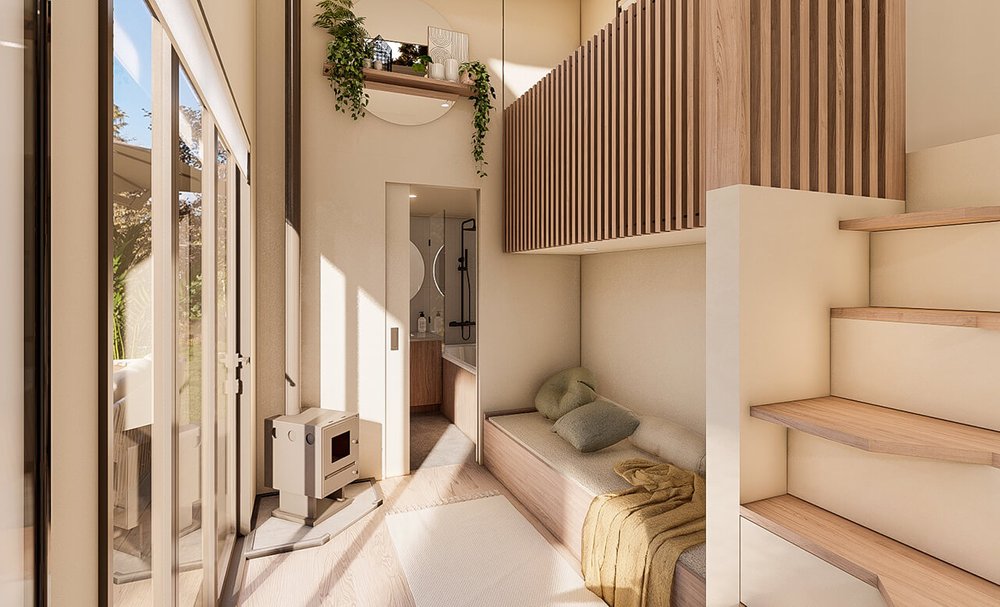
You can spend a year getting the plans right — the loft headroom, the window placement, the exact inch where the fridge door stops swinging — and then undo the whole thing in an afternoon at a big-box furniture store.
It happens constantly. A 484 sq ft cabin gets furnished with pieces designed for a 2,400 sq ft house, and suddenly the room that felt generous on paper feels like a corridor with a sofa in it.
The fix is usually secondhand. Not for the thrift-store romance of it, but for a practical reason most people never think about: older furniture was built for smaller rooms, and it still is.
Old furniture is smaller, and that's not an accident
Rooms in the average new-build home have grown steadily for a century. Furniture grew with them, and it grew faster.
Plenty of mid-century sofas measure 30 to 33 inches front to back. A lot of current models run 40 inches or more — nearly a foot of extra depth, taken straight out of your walkway. The same drift shows up in dining chairs, coffee tables and armoires. Shop 1950s and 1960s furniture and you are essentially shopping a catalogue drawn up for post-war houses that were, on average, less than half the size of today's.
Three more things the old stuff gets right by default:
-
Legs. Mid-century pieces sit up on tapered legs, so you see floor running underneath them. Continuous visible floor is one of the cheapest tricks there is for making a small room read larger. Modern furniture tends to sit flat on the ground and eat the floor plane entirely.
-
Verticality. Tallboys, secretaries and linen presses store the same volume in a third of the footprint of the low, wide dressers that dominate showrooms now.
-
Repairability. A solid wood carcass can be sanded, cut down, re-glued and refinished. A veneered MDF panel can be done exactly once, badly.

Three unusual facts worth knowing before you shop
1. Campaign furniture was tiny-house furniture 200 years early. British officers in the 18th and 19th centuries needed chests, desks and beds that could break down flat and survive a wagon. The result — brass-cornered chests that split into two stackable halves, desks with unscrewing legs, folding campaign chairs — is a whole furniture tradition designed around exactly the constraints a tiny home has. Originals are collectible and pricey; reproductions and Indian-made copies turn up secondhand constantly and are usually cheap because nobody knows what they're looking at.
2. The Shakers hung their chairs on the wall. Shaker meeting rooms and dwelling rooms were ringed with peg rails, and chairs went up on them when the room needed sweeping or needed to be a different room. Their ladder-back chairs were built light specifically so this was possible. A peg rail is about $30 of hardwood, and it is still the single best storage move in a tiny house.
3. The Murphy bed exists because of a courtship. William Lawrence Murphy was living in a one-room San Francisco apartment around the turn of the last century and — as the story goes — wanted to entertain a young woman he was courting without a bed visible in the room. He patented a way to fold it into the closet. Small-space design has always been about what the room becomes when the furniture disappears.
The weight problem nobody warns you about
If you're building on a foundation, skip this. If you're building on wheels, read it twice.
A tandem-axle tiny house trailer is typically rated somewhere in the 10,000 to 14,000 lb range, and a finished house often lands uncomfortably close to that number before you've moved a single box in. Furniture is not a rounding error in that calculation. A solid oak dresser can run 150–200 lb on its own. A cast iron woodstove, a full-size sofa bed and a farmhouse table can quietly add half a ton between them.
Tips for a house that moves:
-
Weigh it, or at least lift it. If you can't get one end off the ground unaided, it's a foundation piece, not a road piece.
-
Prefer pieces that come apart. Bolt-together beds, knock-down wardrobes and campaign-style chests can be carried through a 30-inch door and re-tightened after a move.
-
Favour drawers over doors, and fit them with catches. Drawers that slide freely on a level floor will slide freely at 55 mph on a crowned road. Simple ball-catches or a bar across the front solve it.
-
Steal a trick from boats: a fiddle rail — a low lip around the edge of a table or shelf — is what stops things sliding off at sea, and it works just as well on a mountain pass.
-
Anchor tall pieces to a stud, always. This is a child-safety measure in any house and a structural one in a house that moves.
Five checks before you hand over cash
-
Pull a drawer all the way out and look at the corners. Dovetails — interlocking wedge-shaped joints — mean the piece was built to last. Staples and glue blocks mean it wasn't. Hand-cut dovetails, slightly irregular in spacing, generally indicate a genuinely old piece; perfectly uniform machine-cut ones came in from the 1860s onward.
-
Check whether it's solid wood or veneer. Look at the edge of a tabletop or the top of a drawer front. A thin, perfectly consistent grain line that stops dead at the edge is veneer. Veneer isn't a dealbreaker — much of the best mid-century furniture is veneered over quality ply — but it limits how aggressively you can sand or cut.
-
Smell it. Musty means it's been damp, and damp means possible mould in the carcass. In a house with 1,500 cubic feet of air instead of 15,000, that matters far more than it would in a normal home.
-
Rock it. Loose joints are usually fixable with glue and clamps, which is the cheapest repair in the world. Warped or cracked structural members usually aren't worth it.
-
Assume painted pieces might be hiding lead. Lead wasn't banned from household paint in the US until 1978. If a piece is older than that and painted, do not dry-sand it and do not take a heat gun to it — test it first with a cheap swab kit, and if it's positive, either encapsulate it under a good primer or hand it to someone equipped to strip it safely.

Refinish rather than replace
Here's the part that turns a $40 curbside dresser into something that looks like it was specified for the build: the finish. And it is genuinely, unglamorously learnable — the failures are nearly all in prep, not in the painting.
A few things worth internalising:
-
Degrease before you sand. Decades of furniture polish and cooking film will stop any paint from bonding, and sanding just drives it in. Wash first.
-
Prime knotty pine and anything tannin-rich. Oak and mahogany will bleed pink-brown through a white topcoat months later if you skip a stain-blocking primer.
-
Choose a repairable finish. Wax and shellac can be spot-repaired in place with a rag. Polyurethane can't — a scuff means stripping the whole panel. In a house where every surface gets touched daily, repairability wins.
-
Let paint cure, not just dry. Most latex and chalk paints are touch-dry in an hour and fully cured in two to four weeks. Loading a freshly painted dresser is how you get drawer fronts that stick together.
If you're doing this for the first time and would rather not learn it by ruining something, it's worth working through a set of beginner-friendly guides to painting and restoring secondhand furniture before you open a tin. The difference between a flip that looks intentional and one that looks like a craft project is almost entirely in the boring middle steps.
A note on finish and colour in a small volume
Two small-space specifics that don't apply in a normal house:
Sheen does real work. A satin or eggshell finish bounces light around a room the way flat paint won't, and in a space where the far wall is nine feet away, that's the difference between cosy and dim. Save true matte for ceilings.
Ventilation is not optional. A tiny house has a fraction of the air volume of a standard home, so anything off-gassing — fresh paint, new MDF, solvent-based sealers — reaches a much higher concentration much faster. Finish furniture outside or in a shed, let it cure fully before it comes indoors, and lean toward water-based products where you can.
Keep to two wood tones, maximum. Three or more reads as clutter in a room this size, no matter how good each individual piece is.
The pattern that works is simple enough: buy old, buy light, buy repairable, and put the work into the finish rather than the price tag. A well-drawn plan already does most of the hard thinking about how the space flows. Furniture's only job is to not argue with it.
Browsing layouts? Start with the tiny home plans collection — the material lists are a useful sanity check on what will actually fit through the door.
Share: