

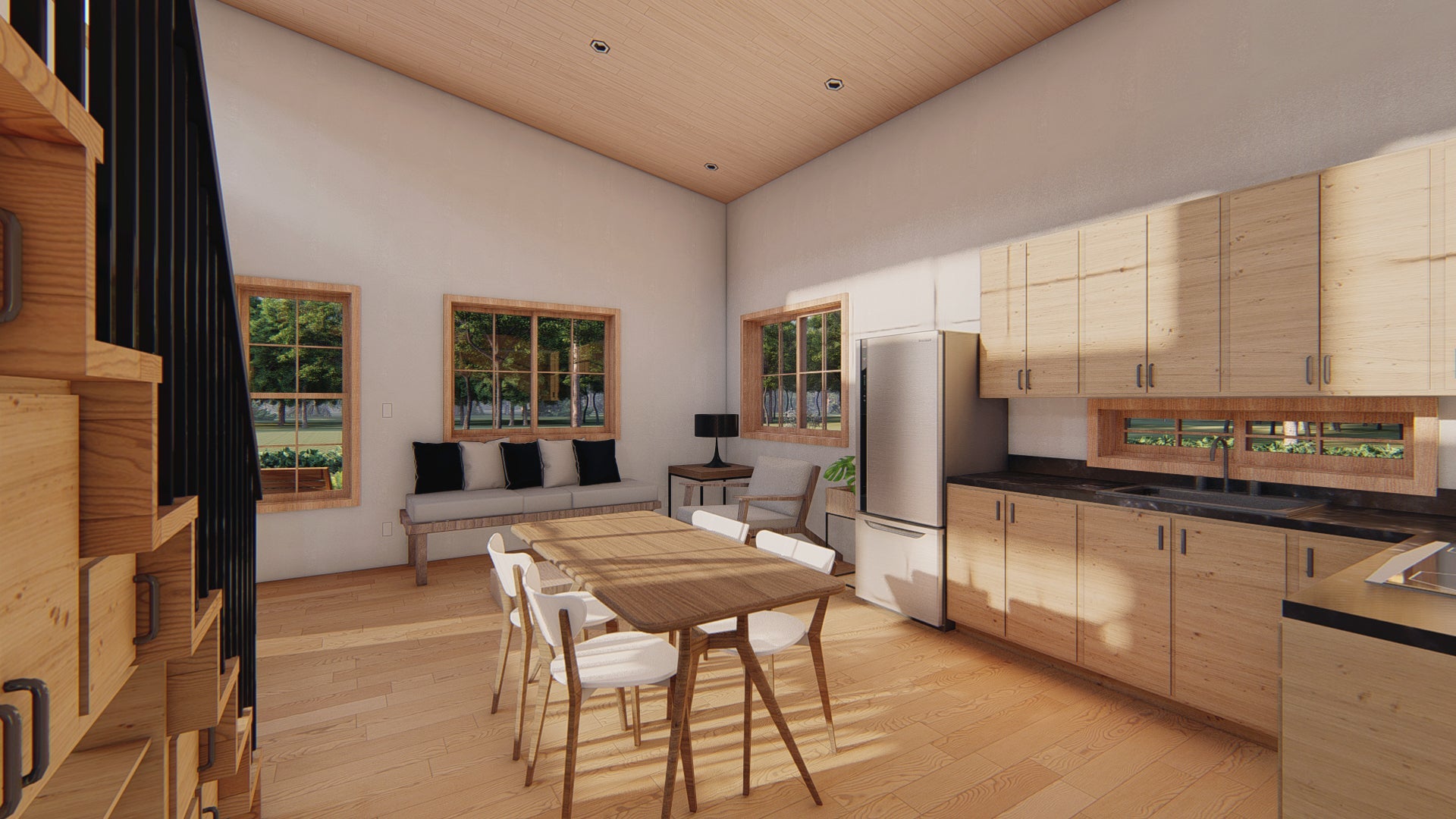
Here’s something nobody tells you before you start building a tiny home: the kitchen will take up more of your mental energy than any other part of the project. I’ve seen people breeze through framing, get creative with their loft designs, then completely stall out when it comes to figuring out where the stove goes.
It makes sense when you think about it. Kitchens are where all the complicated stuff converges—plumbing, electrical, ventilation, storage. In a regular house, you’ve got room to make mistakes. Put the fridge in a weird spot? Fine, you’ll walk around it. But in 80 square feet, bad decisions compound fast.
Where Tiny Kitchens Go Wrong
I’ve toured dozens of tiny homes at festivals and shows over the years. The ones with terrible kitchens almost always share the same problem. The builder tried to shrink a normal kitchen instead of rethinking how small spaces actually work.
You see it everywhere. Upper cabinets blocking the only window. A refrigerator door that slams into the oven door when both are open. Counter space that vanishes the second you set down a cutting board. And don’t get me started on ventilation—or the lack of it. Nothing like your entire 200-square-foot home smelling like fish for three days because there’s nowhere for cooking odors to go.
None of this is inevitable. It happens when people focus on cramming components into a floor plan instead of thinking through how someone actually cooks a meal.

The Work Triangle Isn’t Dead
You’ve probably heard of the kitchen work triangle. It’s an old concept—dates back to the 1940s—but it still holds up. The basic idea is that your sink, stove, and refrigerator should form a triangle shape. Keeps you from running back and forth across the kitchen while you’re trying to get dinner on the table.
In a tiny house, obviously that triangle gets a lot smaller. But the principle still applies. You want your cooktop close to your sink because that’s where the real work happens. The fridge? Honestly, it can sit outside your main work zone. You grab ingredients before you start cooking anyway. Some of the best tiny kitchens I’ve seen tuck the refrigerator around a corner or even into an adjacent space.
Counter Space (Or the Lack of It)
Counter space is where most tiny kitchen dreams go to die. You need somewhere to prep food. Somewhere to set hot pans. Somewhere to stage dirty dishes. And you’re trying to do all of this on maybe two feet of usable surface.
The trick isn’t finding more counter. It’s making surfaces do double duty.
A cutting board sized to fit perfectly over your sink gives you prep space that disappears when you need to wash dishes. Hinged counter sections can fold flat against the wall when you’re not cooking. Cooktop covers that sit flush with the surrounding counter add work surface when the burners are off. These aren’t sad compromises. Boat builders and food truck designers have used these exact solutions for decades. They work.
One thing that helped me understand small kitchens better: think about depth, not just width. Standard base cabinets are 24 inches deep. That’s fine in a big kitchen where you can step back from the counter. In a narrow galley, though, 24-inch cabinets make the space feel like a hallway.
Try 18-inch deep cabinets instead. Or even 15-inch in spots. Yes, you lose some storage. But you gain room to actually stand comfortably while you’re chopping vegetables. That tradeoff is worth it.
This is where working with experienced custom builders can really help. Stock cabinets only come in certain sizes. Custom work means your cabinets fit your space instead of the other way around.

Picking Appliances
Forget everything you know about appliance shopping for a regular house. That 36-inch range with the double oven? It’s not happening here. But downsizing isn’t just about physical dimensions. It’s about matching what you buy to how you actually cook.
Separate cooktops give you way more flexibility than ranges. A two-burner induction unit can be as narrow as 12 inches and handles probably 90% of what most people cook day to day. If you bake a lot, a compact wall oven or a really good countertop convection oven might make more sense than a full-sized unit.
Induction is worth considering seriously for tiny builds. Runs cooler than gas, which matters when your kitchen shares air with your bedroom. Uses less power too—big deal if you’re on a 30-amp service or off-grid.
Refrigerators are tough. Regular fridges hold 20-plus cubic feet. Compact ones might give you 10. That’s the difference between shopping once a week and shopping every few days. Before you automatically buy the biggest fridge that fits, actually think about your habits. If you cook mostly fresh stuff, smaller works. If you meal prep and store leftovers, you need the capacity.
And please, please think about ventilation. Small spaces concentrate cooking byproducts like crazy. Steam, smoke, grease, smells—all of it builds up fast. A recirculating hood that just filters air and blows it back into the room won’t cut it. You need a real ducted exhaust that moves air outside.
The U.S. Department of Energy recommends at least 100 CFM for kitchen exhaust. In a tiny home, I’d go higher. And figure out your ductwork path during framing. Trying to route it after the walls are finished is a nightmare.
Storage That You’ll Actually Use

There’s a temptation to cram in as many cabinets as possible. More storage seems better, right? But bad storage creates its own problems. Stuff gets buried. You forget what you have. Six months later you find a can of beans that expired in 2019 hiding behind your slow cooker.
Good storage in a tiny kitchen is about access, not just volume.
Go vertical. Wall cabinets that run all the way to the ceiling capture space that usually sits empty. Sure, you need a step stool for the top shelf. So what? Put your everyday dishes at eye level and the roasting pan you use twice a year up high.
Open shelving works in tiny kitchens if you’re honest with yourself about keeping things tidy. One shelf above the sink for glasses and daily plates can look great and save you from the visual weight of another closed cabinet.
Drawer bases instead of regular cabinet shelves. Yes, they cost more. They’re also way easier to use. You can see everything at a glance instead of crouching down and digging around in dark corners. In a tiny kitchen where every cabinet matters, this upgrade pays for itself in reduced annoyance.
And look into those skinny floor-to-ceiling pull-out pantries. Some are only six inches wide. They slide into gaps between appliances that would otherwise be wasted space, and they hold a surprising amount of dry goods.
Lighting Makes a Bigger Difference Than You’d Think
Natural light is your friend. If your floor plan gives you any flexibility at all, put the kitchen near windows. Cooking in a dark corner gets depressing fast.
For artificial light, don’t rely on just one overhead fixture. It’ll cast shadows exactly where you need to see—on your cutting board, in the sink, across the stove. Under-cabinet lights fix this and make the space feel bigger too.
Dimmers are worth the extra few bucks. When you’re cooking, you want bright task lighting. When dinner’s done and the kitchen becomes your living room again, softer light feels right. In a tiny home where every room is the same room, that flexibility matters more than you’d expect.
Wrapping Up
Getting a tiny kitchen right means holding two ideas in your head at once. You have to respect the constraints of limited space while also refusing to settle for a lousy cooking experience. Those aren’t contradictory goals. They just require more thought than a bigger kitchen would.
My advice: before you make any decisions about layout or appliances or storage, document how you actually cook. Not how you think you should cook. How you really cook, day to day. That honest assessment should drive everything else.
The best tiny kitchens don’t feel like sacrifices. They feel intentional. Efficient. Right. That doesn’t happen by accident. It comes from taking the design process seriously—just as seriously as you’d take a kitchen three times the size.
Share: