

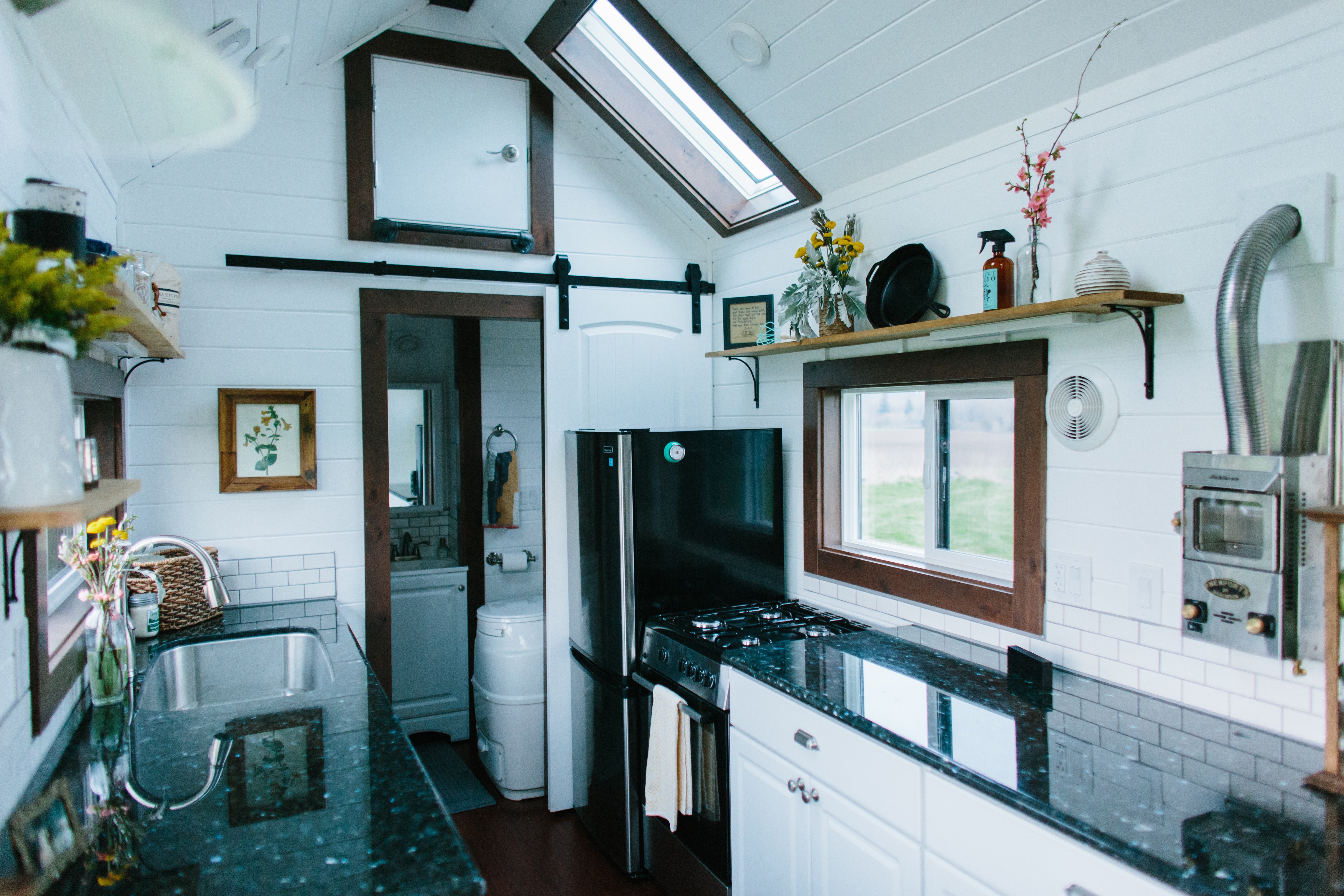
You can make a tiny house kitchen work harder by zoning prep, cook, wash, and storage so you don’t waste steps. You’ll choose layouts that fit your footprint—L-shaped for corners, one-wall for the tightest plans, or a galley for clean traffic flow.
Add a slim peninsula or rolling cart for extra prep and seating, then go vertical with a tall pantry. Finish with a deep sink, pull-down faucet, and under-cabinet lighting—but that’s just the start.
Key Takeaways
-
Plan four kitchen zones—prep, cook, wash, storage—to minimize steps; keep prep beside the sink and essentials within arm’s reach.
-
Choose an L-shaped, one-wall, or galley layout; use corner pullouts or lazy Susans to eliminate dead space.
-
Add multifunctional pieces like slim peninsulas, rolling carts, and fold-down ledges to expand prep and seating without crowding.
-
Maximize vertical and hidden storage with full-height cabinets, toe-kick drawers, pull-out pantries, rails, pegboards, and magnetic strips.
-
Select compact, efficient appliances and smart cleanup tools like drawer dishwashers; use under-cabinet LEDs and reflective finishes to brighten the space.
Map Prep, Cook, Wash, and Storage Zones
Start by mapping four zones—prep, cook, wash, and storage—so every step stays within a tight triangle and you don’t waste inches walking. Place your prep station beside the sink, then anchor the washing zone with a compact basin and pull-down sprayer.

Boost cooking efficiency by keeping oils, spices, and utensils in a narrow caddy within arm’s reach of the stove. Use layout strategies like vertical rails, magnetic strips, and under-shelf baskets as storage solutions that don’t steal counter depth. Add multifunctional furniture: a flip-up counter, rolling cart, or cutting-board sink cover for extra workspace.
Apply space saving techniques with labeled bins and clear jars for instant inventory. Finish with cleaning hacks—stash wipes, brush, and soap in a toe-kick drawer—while keeping design aesthetics cohesive.
Choose an L-Shaped Layout for Corner Efficiency
If you want to wring every inch out of a tiny kitchen, an L-shaped layout lets you turn an awkward corner into your most efficient work hub. You’ll keep traffic out of your work zone while gaining continuous counter runs for prep and landing space. Place your sink on one leg and your cooktop on the other to create a tight, two-step triangle that feels bigger than it is.
Use corner cabinets with a lazy Susan, swing-out trays, or a LeMans pullout so you don’t lose depth to dead space. Add vertical dividers for sheets, a narrow spice pullout near the range, and an under-sink caddy to cluster cleaners. With intentional shelf heights and labeled bins, you’ll build reliable space saving storage without clutter.

Use a One-Wall Layout for Ultra-Small Footprints
In the tightest tiny houses, a one-wall kitchen puts sink, cooktop, and fridge on a single run to keep your aisle clear and your steps short.
Keep minimalist decor and tight color coordination so the line feels longer and cleaner, and boost natural lighting with a reflective backsplash and under-cab LEDs.Build efficient storage upward: use vertical organization with clever shelving to the ceiling, a rail system for functional accessories, and a magnetic strip for knives. Add hidden compartments in toe-kicks and a pull-out pantry between studs for space saving solutions.
Choose multifunctional furniture like a fold-down prep ledge or rolling cart that docks under the counter. Standardize containers, label zones, and leave one open landing spot so you’ll actually cook, daily.
Pick a Galley Layout for Smooth Traffic Flow
When you want a kitchen that feels effortless in a narrow tiny-house corridor, a galley layout keeps traffic moving while concentrating every task into a tight, efficient zone. You create clear traffic patterns by placing counters on one or both sides and preserving a straight aisle that doesn’t pinch at doors or appliance swings.
For layout efficiency, keep the sink, cooktop, and fridge within a few steps, then align storage directly above or below each station to support workspace flow. Prioritize kitchen ergonomics: set frequently used items between knee and shoulder height, and leave landing space beside the stove and sink.
Key design considerations include 36-inch minimum aisle width, shallow uppers, and under-cab lighting to improve user experience. This functional design makes a small space feel organized, fast, and safe daily.

Add a Slim Peninsula for Seating and Prep
Because floor space is your tightest constraint, a slim peninsula adds a hard-working edge that doubles as prep counter and casual seating without widening the kitchen’s main aisle. Keep it narrow, then choose slim seating like backless stools that tuck fully underneath for easy access and faster cleanup.
Build in multifunctional design: add a shallow drawer for utensils, a pull-out trash, and open cubbies for stylish storage of cutting boards and daily mugs. You’ll gain prep space where you chop, plate, and serve in one spot, supporting versatile usage from coffee bar to laptop perch.
Finish the end panel with hooks or a magnetic strip so tools stay within reach. A warm wood top and under-counter lighting create a cozy atmosphere while staying true to space saving solutions.
Measure Clearances Before You Buy Appliances
Before you order that “perfect” compact range or counter-depth fridge, measure every clearance it needs to function—door swing, handle depth, ventilation gaps, and the space required to slide it in and out for service. Confirm appliance sizes against real kitchen dimensions, not brochure drawings.
Take clearance measurements at floor, counter, and upper-cabinet heights, because trim, outlets, and window sills steal inches. Map appliance placement with tape on the floor so you can test an ergonomic layout and an efficient workflow between sink, cooktop, and prep zone.
Check aisle widths when a dishwasher or oven door is open, and verify drawers still clear pulls. Plan compact storage around these swing paths. Good spatial planning supports functional design without sacrificing design aesthetics.
Choose Compact Appliances That Actually Fit
Even if a “compact” appliance looks tiny online, you’ll only win in a small kitchen if its real dimensions match your exact footprint and workflow. Choose space saving designs with front controls, reversible doors, and zero-clearance hinges so you keep efficient layouts tight.
Favor hidden appliances like under-counter fridge drawers or a slim dishwasher panel that disappears behind sleek finishes. Pair them with multi functional furniture: a microwave shelf that doubles as modular shelving, or a pull-out pantry with integrated storage for compact dishware.
Use vertical organization by stacking a ventless washer or mounting small appliances on rail systems. Add portable workstations that roll to outlets, then tuck away. Verify plug orientation, door swing, and ventilation, and you’ll avoid dead zones.

Switch to a 2-Burner Induction Cooktop
Two burners can handle most tiny-house meals while freeing up valuable counter and cabinet space. With induction benefits like rapid cooking speed and precise heat control, you’ll boil, sear, and simmer without wasted watts, boosting energy efficiency.
Choose space saving designs: a flush-mount unit for a seamless look or a drop-in model with a thin profile for tight cutouts. If you need flexibility, consider portability options so you can stow it after cooking or use it outdoors.
Prioritize safety features—auto shutoff, pan detection, and cool-to-touch glass—to protect you in close quarters. For versatile cookware, keep a magnetic skillet and saucepan that nest. Follow installation tips: confirm amperage, venting clearances, and countertop heat ratings for durability.
Pick a Slim or Under-Counter Fridge
If you want cold storage without sacrificing your prep zone, pick a slim or under-counter fridge that fits your layout and your grocery rhythm.
A slim design tucks beside a base cabinet or under a worktop, boosting space optimization while keeping the aisle clear. Prioritize energy efficiency with an inverter compressor and tight door seals, so it won’t drain your off-grid setup. Look for modern cooling technologies like multi-airflow or frost-free control to protect produce and prevent icy buildup.
For storage solutions, choose adjustable shelves, a deep door bin, and a crisping drawer sized for weekly staples. Match finish and handle style for aesthetic appeal, and confirm appliance compatibility with your cabinet depth, hinge swing, and ventilation needs for user convenience.
Consider a Drawer Dishwasher (or Dish Rack Plan)
Once you’ve sized your fridge to your real grocery flow, make cleanup just as streamlined by choosing a drawer dishwasher—or locking in a dish rack plan that won’t steal counter space. A single-drawer unit fits under a standard counter, runs half-loads, and lets you wash only what you used.
Pick a panel-ready front to keep visual lines clean, and confirm door swing won’t block a narrow aisle. If power, plumbing, or budget says no, commit to compact dishwashing solutions: a deep, single-bowl sink with a pull-down sprayer and a fitted basin for wash/rinse.
Then add innovative drying options: an over-sink roll-up rack, a wall-mounted folding rack, or a toe-kick vented tray that drains into the sink.
Use a Microwave–Convection Combo Oven
Because counter and cabinet inches matter in a tiny kitchen, a microwave–convection combo oven earns its footprint by handling reheats, bakes, and quick roasts in one appliance.
You get microwave versatility for leftovers, plus crisp convection heat for cookies, sheet-pan meals, and browned casseroles, improving cooking efficiency without adding a second oven.
Choose a built-in or slim countertop model with a space saving design, and confirm clearances, venting, and wattage before appliance selection. Use multifunctional usage presets—sensor reheat, convection bake, and combo roast—as true time saving features that reduce babysitting.
Look for an inverter, insulated door, and standby-off mode for better energy efficiency. Match the finish to your hardware so it supports kitchen aesthetics while still wiping clean fast.

Add a Fold-Down Table for Dining or Prep
A microwave–convection combo frees you from a full-size oven, but you still need a spot to chop, plate, and eat without sacrificing floor space. Add a wall-mounted fold-down table that locks flat when you’re done, and you’ll gain instant prep and dining capacity.
Mount it near your fridge or sink to streamline workflow, and choose a slim bracket rated for real weight. Look for foldable furniture with a wipe-clean surface, rounded corners, and a lip to stop dishes from sliding.
Pair it with nesting stools or a bench that tucks under to support portable dining. For true space saving solutions, pick multifunctional designs: a table with a built-in spice rack, paper-towel holder, or knife strip on the underside. You’ll keep counters clear and meals effortless.
Install a Pull-Out Counter Extension
If your tiny-house counters vanish the moment you set down a cutting board, install a pull-out counter extension to create extra prep space only when you need it.
Mount it beneath an existing countertop or above a drawer bank so it glides out like a shelf and locks level with the main surface.
Choose from counter extension styles such as a simple plywood panel, a butcher-block slab, or a slim laminate top that matches your counters. Add heavy-duty full-extension slides, a front finger pull, and a positive stop so it can’t drift.
For easy installation, screw the slide members into solid cabinet sides, shim for perfect alignment, and seal all edges against moisture. Push it back in to reclaim aisle clearance.
Use a Rolling Island Cart You Can Park Away
Pull-out extensions add prep space in place, but a rolling island cart gives you a full work surface you can move where it works best, then park out of the way.
Choose a narrow cart that clears your walkway and fits beside the fridge, under a counter overhang, or against a blank wall when you’re done. Locking casters keep it steady for chopping, mixing, or setting a hot pan on a trivet.
Use the top for daily prep, then roll it next to the stove as a landing zone. The rolling cart benefits add up: extra counter area, mobile storage, and a pop-up serving station. That kitchen flexibility helps you host, clean, and cook without crowding your tiny layout.
Add Toe-Kick Drawers for Flat Items
Hidden in plain sight, toe-kick drawers turn that dead strip under your base cabinets into slim storage for flat, awkward items.
You’ll free up prime drawer space by sliding baking sheets, cutting boards, cooling racks, placemats, and silicone mats into a shallow, full-width tray. For better toe kick organization, sort by frequency: daily boards near prep zones, rarely used trays near the oven. Add low-profile dividers so stacks don’t migrate when you open and close the drawer.
Choose a soft-close, full-extension slide so you can reach the back without kneeling forever. Label the inside edge for quick grabs, and keep one spot for a thin step stool. This hidden storage stays invisible, yet it works hard every day.
Use Full-Height Cabinets to the Ceiling
Because every inch counts in a tiny house, run your cabinets full-height to the ceiling so you capture that often-wasted gap above standard uppers.
Full height cabinetry turns dead air into vertical storage for rarely used items like seasonal serveware, bulk dry goods, and backup paper products. Install an uppermost “attic” shelf behind a simple door, and keep a small folding step stool nearby so you can reach it safely. Use adjustable shelves to fit tall bottles and appliances, and add interior dividers for trays and cutting boards to prevent leaning chaos.
If you’re remodeling, align cabinet tops with ceiling joists and use scribe molding to close uneven gaps, reducing dust traps and making the kitchen look taller and cleaner overall.

Add a Rail System for Tools and Towels
Full-height cabinets handle the bulk storage, but you still need your everyday tools within arm’s reach without crowding the counter. Mount a slim rail along the backsplash or under upper cabinets and use it for hooks, towel bars, and small caddies. You’ll free drawer space while keeping essentials visible and easy to grab.
Place a hand towel and dish towel on separate bars so they dry faster. Add S-hooks for a measuring spoon ring, oven mitts, or a small strainer. Choose stainless or powder-coated rails for easy wipe-downs, and cap the ends to prevent snags.
Keep the layout tight: hang only what you use weekly and group by task. This rail becomes one of your best kitchen organization and space saving solutions.
Hang a Pegboard for Daily-Use Utensils
A wall-mounted pegboard gives you flexible, vertical storage for the utensils you reach for every day without eating up drawer space. Mount it near your prep zone so you can grab a spatula, ladle, or whisk in one motion.
Plan pegboard organization before drilling: group tools by task, keep your most-used pieces at eye level, and leave a small buffer between hooks so handles don’t tangle.
Add small bins for measuring spoons, clips for towels, and a narrow shelf for timers or oils. Use labeled outlines or hook positions to reset the board fast after cooking.
Choose rust-resistant hooks, and anchor into studs or use heavy-duty drywall anchors so it won’t wobble. This setup improves utensil accessibility and keeps counters clear.
Mount a Magnetic Strip for Knives and Spices
Even if you’ve got only a sliver of backsplash to work with, a magnetic strip turns that vertical space into instant storage for knives and metal-lidded spice tins. Choose a strong magnetic knife bar, anchor it into studs, and keep blades separated so edges don’t nick.
For spice organization, decant into matching magnetic tins or use metal caps, then label the bottoms for quick grabs. Mount the strip at eye level to boost space efficiency and prevent cluttered counters.
Place it away from the stove’s heat and splatter zone, and keep sharp knives above kid reach for kitchen safety. This is one of the simplest wall mounted solutions: it’s fast to wipe, easy to rearrange, and delivers creative storage with real aesthetic appeal in a tiny kitchen.
Install Slim Open Shelves for Often-Used Items
When you reach for the same mugs, bowls, oils, or salt every day, slim open shelves keep them within arm’s reach without eating up precious depth. Mount them above your counter or beside the sink to boost vertical organization and free drawer space. Choose lightweight materials like thin wood, aluminum, or steel brackets, and anchor into studs for strength without bulk.
Use shelf styling that’s tidy and repeatable: group like items, keep labels forward, and limit extras so dusting stays quick. Mix decorative storage with daily tools—matching jars, a small tray for spices, and one plant—so it reads as space saving decor, not clutter. This minimalist design delivers easy access while maintaining functional aesthetics in your tiny kitchen.
Hang a Ceiling Rack for Pots and Pans
Since cabinet real estate disappears fast in a tiny kitchen, hang a ceiling-mounted pot rack to shift bulky cookware up and out of your working zones.
Mount it into joists, keep it centered over an island or prep run, and size it so pans don’t bump your head. This ceiling storage doubles as a decorative display, adding visual interest while keeping your best pieces in easy access. Use S-hooks for pots, a rail for lids, and a small basket for strainers to improve space organization.
Match finishes to faucets or lights to refine kitchen aesthetics, and keep heavier items near anchor points for functional design. Add a narrow hanging solutions bar for utensils to consolidate clutter and streamline cleanup.
Build a Tall Pantry Cabinet for Dry Goods
Ceiling racks free up overhead space, but you’ll still need a dedicated zone for staples, so build a tall pantry cabinet to corral dry goods in one slim footprint.
Place it beside the fridge or at the end of a run so it won’t steal aisle width. Use full-extension pull-out shelves so you can see every can and box. Add adjustable pins to match cereal, pasta, and baking bins, and keep heavier items low for stability. Mount the cabinet to studs and add a toe-kick drawer for flat packets.
Install door racks for spices and wraps, plus labeled, clear containers to tighten pantry organization. Go all the way to the ceiling for true vertical storage, and cap the top shelf for rarely used backups.
Choose a Deep Single-Bowl Sink
How do you make a tiny-house sink area work harder without adding inches? Choose a deep single-bowl sink. One uninterrupted basin fits sheet pans, stockpots, and nested dishes, so you won’t need extra counter space for soaking or staging.
The deep sink benefits include fewer splashes, better containment of prep mess, and more usable vertical volume for washing and rinsing. Go for a compact footprint with maximum depth, and pair it with a slim, offset drain to keep the bottom flatter for stacking.
For ergonomic considerations, set the sink at a comfortable height and pick a depth you can reach without hunching; a slightly raised sink base can reduce back strain. Install sound-deadening pads to keep it quieter too.

Add a Pull-Down Faucet for Easier Cleanup
A pull-down faucet turns a tiny sink into a flexible cleanup station without adding counter space. You can rinse tall pots, blast food off plates, and sweep crumbs from corners with a targeted spray.
Choose compact faucet styles with a high-arc spout and a retracting head so you don’t need extra accessories. A dual-function spray/stream button improves cleaning efficiency for both gentle rinsing and stubborn messes. Look for a swivel spout to reach every side of a deep single-bowl sink, plus a magnetic dock to prevent sagging.
Install a single-handle mixer to control temperature one-handed while you hold cookware. Add an anti-splash aerator and a pull-down hose long enough for quick sink-to-counter wipe-downs too.
Brighten With Under-Cabinet Lighting and Light Colors
Because tiny kitchens hide shadows fast, install under-cabinet LED strips to put bright, even task light exactly where you prep and cook. Choose dimmable under cabinet lighting with warm-to-neutral settings so you can match light color schemes for cooking, dining, or late-night snacks.
Pair pale cabinetry with bright accents on towels or canisters to add energy without clutter. Use reflective surfaces like glossy backsplashes, stainless panels, and glass jars to bounce light and stretch sightlines. Keep windows clear for natural light, then add vibrant decor in small doses for a cohesive design.
Lean on creative storage up the vertical space—rails, hooks, and magnetic strips—so counters stay open for multi purpose items like cutting-board covers and nesting bowls.
Conclusion
You can make a tiny house kitchen work hard by zoning prep, cook, wash, and storage so you’re not backtracking. Pick the layout that fits—L-shape for corners, one-wall for the tightest plans, or galley for clean flow.
Add a slim peninsula when you need seating and extra prep. Go vertical with a tall pantry, choose a deep single-bowl sink, and use a pull-down faucet. Finish with under-cabinet lighting and light colors.
Share: